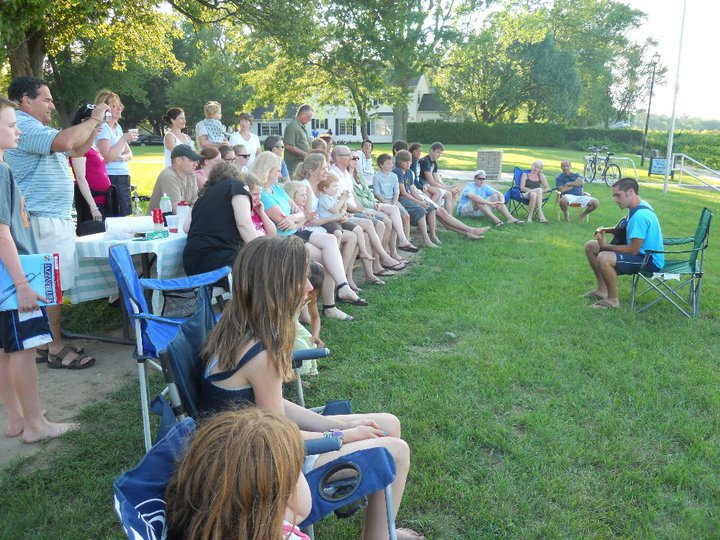
It has been about seven months since I published the first run of Preacher Kid and one thing that has not dissipated over those months is my nervousness over “putting myself out there.” I have always enjoyed being a behind-the-scenes worker, playing supportive roles, not seeking the spotlight. In my illustrious business career, I have developed decent presentation skills by accepting the requirement of a marketing manager who must present ideas, status, conclusions, strategic plans, and product demonstrations to audiences large and small. But that aspect of the job description has never been an area of great comfort for me. The best feeling I get out of presenting is the relief that rolls over me when I'm done.
From a certain angle, Preacher Kid is one long, continuous presentation – up to this point, made mostly behind the Internet's curtain of anonymity. Even so, I stress regularly at the thought that maybe my writing skills are not really worthy of publishing or at the fact that, stubbornly acting as my own editor, I missed many typos, having read the draft so many times that I could no longer see it. I really do know the difference between “where” and “were!” In fact, I currently get paid to copy/edit. My co-worker even gave me a coffee mug with a spelling rule emblazoned on it, in thanks for my respected grammar-girl role in the department.
But editing copy under a deadline of a few hours is very different than proofing the manuscript I developed as a labor of love for 7 years. Thank goodness for self-publishing, its on-demand printing, and the option to re-submit files with a 24-hour turn-around.
The curtain will open this month as I participate in my first book signing, which takes place on Thursday, July 25th at Joseph-Beth Booksellers in Cleveland (11:00am to 2:00pm). I imagined a modest book tour when I first published Preacher Kid – one involving a trip to each of the nine Ohio towns and cities lived in by Esther Miller. Unfortunately, I don’t have the time or resources to take that tour at this stage in my life. So my dream book tour will take place in slow motion, with a start this month and future stops to be determined! I contacted one independent book store in Cleveland (chosen because it had been my mom's favorite bookstore when it was located out on Cedar Road) and they said “yes.” Should I have contacted more? Yes. Do I think other bookstores would be interested? Yes. But I will have to test that theory some other time. Right now, I am only willing to give up one day of my family vacation in Ohio for the book!
So I will bring my box of books and my “favorite pens” (the bookstore's recommendation) with me to Ohio and step onto the tiny stage. Any book-signing advice you can offer me is most welcome. My crew at home has set me up with the advice to bring a crossword puzzle to work on! Thanks for the vote of confidence! If you are in the Cleveland area on July 25th, please come say hello between 11 and 2. I will be the one at the table with the pens and the nervous smile. And no crossword puzzle.
Connect to your communities. Promote your brand. Build your business.
Small Business Social Media Tips & Author Blog For Kathleen M. Walsh
Wednesday, July 10, 2013
Sunday, June 16, 2013
Had the Time of His Life
My dad had a funny relationship with his mother-in-law. It
was one of those relationships that you had to witness to vaguely understand.
You also had to live with my dad to appreciate what he invested and tolerated in
that relationship. But what it all boiled down to was the fact that my dad
enjoyed my grandma. Despite the fact that she never really took her foot off of
his neck – not since he left my mom in the lurch and went into the seminary his
sophomore year of college when his parents gave him no other option.
What we saw, especially in Esther’s senior years, was a
dance of two sharp-witted people: Esther never letting my dad forget that he
was constantly under scrutiny and my dad always intent on making Esther laugh.
I think she was a sucker for his humor and charm, even though she would never admit
it. In the end, I have never seen a son-in-law willingly and enjoyably give so
much of his time and energy to his mother-in-law. And I’ve seen a lot of
things.
My dad was definitely grateful to Esther. She gave him the
best thing he ever got out of life. She also outlived my dad’s mother by over
20 years. So maybe she filled a void for him, in a way.
I had a fun relationship with my dad. He had his stressful
moments, but, honestly, those are blurry, rare spots in my memory bank. Except
for the time he backed out of his parents’ driveway after a much-needed
drop-off of kids and bent the rear passenger door backward against the
brick house because one of us forgot to close it! That one sticks! But
even that is more legend than scar. Fatherhood is hard work. Even in the 60s
and 70s when we recall how men were less involved with childrearing, it was
hard work in a different way. Most of my dad’s working life was spent in jobs
he really didn’t like. An amazing thing about those situations is that none of
his co-workers ever knew he was dissatisfied. Even more amazing is he kept his
career disappointment out of the house. I think that is a phenomenal accomplishment,
while feeding a family of 6 by working jobs he really couldn’t stand.
![]() |
| Me, Maureen & Dad |
He wrote us each letters on the day we were born and tucked
them away for safe keeping. He helped me figure out what it means to be a good
person and how a man should love and respect his wife. He always showed up. He gave and he gave and
he gave. He made me laugh until I cried.
He went out of his way to give strangers a pick-me-up. You never knew when he would burst out in a public place and start a conversation with someone nearby. You always knew he would try to break up the monotony of a waitress' day with his "surprise me" order. He enjoyed what he had. And when his physical mobility was slowly, then rapidly, taken from him, he accepted it with amazing grace and humor.
I take so many pointers from him, it would be silly to list them here. But most recently, he is reminding me to not wish for things to be different: To enjoy what I have. "Having the time of my life" wherever he went was borderline crazy - or at least appeared so to outsiders. You were right, all along, Dad!
Monday, May 20, 2013
Target Practice
A forty-something year-old woman in casual business attire walks into a suburban salon/spa and the two women working the counter literally fall over themselves to get a brochure into her hands. What do you think they spotted first? The unchecked gray in her hair? Her un-manicured nails? Or the face lacking all traces of the scant make-up applied 8 hours earlier? She is exactly the customer they target.
Unfortunately for them, that woman was me. And all I was
looking for was the single salon hair product I buy about once every 6 years
because I use so little of it. But I was flattered, in a comical way! No one
has fallen all over themselves to get to me since my boys were toddlers! The
two times in my life I’ve gone to a beauty spa, I only went upon coercion from
friends. It is awkward and uncomfortable to me and not something I seek out. But
for every one of me, there are 50 other women who love the experience and keep
the salon/spas in business. They correctly identified me on the surface. But
I’m an outlier!
I think about that funny encounter as I research target companies in my day job and as I attempt to
define my target reader audience for Preacher Kid. Sometimes the target market
is so well defined and so recognizable that it walks right up to you and says “hello.”
Other times, it takes more finesse, not to mention trial and error, to locate
the company or person who will be receptive to the “brochure.”
I am excited to be invited to speak at my local library as
part of their annual speaker series. The single reason they were receptive to
my "brochure" is because I adjusted my target to highlight my journey of
discovery. I am joining them not because my book is such a sensation. In New
England, far from Esther Miller’s roots, the attraction to the book about a girl
from Ohio lies more in the research process than the story. And I have to say, I
am thrilled to present my research journey, especially if it demystifies the
process or encourages others to start their own search. Of course I would
love to talk about Esther, but it would probably feel like sharing my home
movies with strangers! Not that that ever stopped my Grandpa McCarthy – invited
by the Lakewood Library, on many occasions, to show his films from his globetrotting!
I discovered that my local library offers free use of
Ancestry.com from their PCs. I think this is a common, yet often overlooked,
benefit offered by many public libraries. I spent hours there, inputting ancestral
names, deciphering cursive census entries from the 1800s, following a
genealogical path down the decades until I lost the trail, and combing through
birth, marriage, and death records trying to match names and dates to fill in the
missing puzzle pieces. I found the whole task utterly captivating and was often
startled out of my seat by the library bell notifying patrons of the impending
close.
Some people put off the research because it seems
overwhelming, they think it will be tedious, or they don’t realize how
accessible old records have become. Not only is it accessible, it is free. I
gathered many stories and memories from my living relatives, but that still
left many holes in the story. Every bit of research to fill in those holes came
from sitting at my computer or the library’s computers – with the important
exceptions of my mom and sister, Megan’s, fact-finding mission to Asheville and
my time, elbows-deep, in the archives at the Western Reserve Fire Museum in Cleveland. There is so much at our fingertips! It is simply
amazing.
It is off in the distance a bit, but mark your calendars for
January 26, 2014 and please come to the Needham Library for a fun little
journey. Party at my house afterwards! Complete with home movies.
Friday, May 3, 2013
The Risk of Waiting Too Long
![]() |
| Max & Edna (1940-something) |
Like most of his siblings, Max Miller lived a long life. He stayed sharp as a tack right up until he died at the age of 87. Which is why I sought him out when I was trying to put the pieces of my grandma’s life together. He would still have the childhood memories, the stories of making do with what they had, the color on his parents, and the dirt on Esther.
It had been years since I had seen Uncle Max. I probably last saw him when I was in high school. He had lived with his wife, Edna, in Columbus and we used to love to drive down there and motor around on his pontoon boat that he docked at the bottom of the hill that led to their house on a lake. Max and Edna never had any children, but they loved children. It was always great fun to visit them and get a chance to laugh with Aunt Louise, who was part of the Columbus package.
So as my thoughts were swirling and forming in 2006, I wrote a letter to Uncle Max who had for many years lived in Lakeland, FL. In the letter, I suggested taking a trip to Lakeland, spending a few days with him, and capturing his memories as well as spending some precious time together.
Do you sometimes calculate a letter’s journey? I do it fairly often. And I knew that it would take 2 days to get from Boston to Lakeland. Then I wanted to give him a few days to process the idea. Then I would give him a call.
The day before I planned to call Uncle Max, my mom called to tell me that Uncle Max had died earlier that day. He had had a long life. He died peacefully in his sleep, like the turning off of a switch. He had been a very small presence in my adult life but he was a link to my grandma that I had come so close to reconnecting. My husband jokingly blames me for Max’s death! But I’m grateful that perhaps Max opened my letter, felt love and appreciation from a distant source, pictured my sisters and I rolling and laughing down the hill in front of his house, thought about his long life and his family a bit, and smiled.
Many people’s reaction to reading Preacher Kid has been one of reinforcement that they should write the life story of a relative or other influential person in their life. I can’t tell you how many times I have heard, “I should write a book about my [fill in the blank].” Well, my advice to you is “do it.” And do it now, before it is too late! The book about my grandma’s life would have been exponentially richer if I had written it while she was alive and helping me. It would have been more colorfully illuminated had her brother, Max, had a hand in it. I think I did alright with the great help from my mom and aunt. But I wish I had written it sooner.
Do you have someone you want to write about? What are you waiting for?
Sunday, April 21, 2013
Help. Thanks. Wow.
One day, not that far from now, I’m quite sure my oldest son will run the Boston Marathon. On that day, my plan will be to cheer him on at the half-way mark, then bike into Boston to meet him at the finish line. It will be a forever-changed finish line from the pre-bombing one we were used to seeing. But I echo the shared feelings of those who love the Boston Marathon and its special day in firmly believing we will do everything we can to heal the survivors, honor the victims, and learn from this week’s horrible tragedy to enable it to continue as the iconic event it is. Saving the event is important for our city's and nation's psyche. But saving the shattered people left in the bombing's wake is the ultimate goal.
I have turned numerous times this week to Anne Lamott’s book, Help, Thanks, Wow: The Three Essential Prayers. This week, there was much reason to call out for Help. Not so much for Thanks and Wow. But in all of the stress, fear, and loss, the light of the Thanks and Wow poked through the black. And it is the sources of the Thanks and Wow – the first responders, others who responded when it was not their assigned role, courageous victims, the Boston police chief, our governor, the fantastic people of Boston & Watertown, the country that showed over and over that they care – that will continue to help us balance our new feelings of vulnerability with the courage we need to live in this crazy, unpredictable world.
Help the victims and their families heal physically and mentally. Thanks for the gift of people who, through training and/or instinct, run toward danger when they think they may be able to help. Wow, we are a magnificent, strong people when we put our differences aside and work in an amazingly united front, constructively toward a common goal.
Pray for Peace.
Monday, April 8, 2013
Starting from My Own Beginning
If you planned to go to an author visit at your local library or book store and your two choices were to see:
(a) a local author, discussing her first book about a 20th century woman who spent most of her life in a distant state or
(b) an author visiting her childhood city, discussing her first book about a 20th century woman who lived in your city, grew up in your state and had family connections throughout your region,
I think most would choose the latter. With this in mind, I’m focusing my initial marketing efforts in the Cleveland area, with a parallel campaign in the markets near my current home.
Two Cleveland Plain Dealer (PD) columnists I enjoy reading are Connie Schultz and Regina Brett. So they have landed on the top of my target list. Ms. Brett was even nice enough, two years ago, to suggest a Cleveland publisher to me. That publisher is also on my list – I’m always open to allowing second chances! When I crafted my letters to these Clevelanders, I leaned heavily on my Grandpa Joe’s memory, even though I think they will find my grandma’s story compelling purely from their own personal vantage points.
Amazingly enough, the man at the PD who edited my grandma’s obituary and both of my parents’ obituaries knew my grandpa personally. There are still people at the Plain Dealer who were starting out as my grandpa was exiting, who remember him. Columnists for the Plain Dealer should recognize his name. If not, I would highly recommend that they set aside some quality reading time in the PD archives with some of Joseph F. Saunders’ columns, getting to know him and Cleveland in the mid-1900s.
Here is what I hope will pique these Clevelanders’ (and others’) interest:
One of my personal goals is to interest Rocky River Public Library in an author visit highlighting Preacher Kid. Not only did I spend hundreds of hours in that building in my pre-internet youth, but Esther was a patron as a Rocky River resident, it never stopped being one of my dad’s favorite places to explore, and my mom served on their Board of Trustees for a number of years. If I were given the opportunity to discuss Preacher Kid at the Rocky River Public Library, I would most certainly be visiting in my family’s honor.
The Cleveland area is my starting point. But I’m pulling out my map of Ohio again and charting my course to match my grandma’s journey. And figuring out who I can stay with along the way! Cleveland is all set – thanks Anne!
(a) a local author, discussing her first book about a 20th century woman who spent most of her life in a distant state or
(b) an author visiting her childhood city, discussing her first book about a 20th century woman who lived in your city, grew up in your state and had family connections throughout your region,
I think most would choose the latter. With this in mind, I’m focusing my initial marketing efforts in the Cleveland area, with a parallel campaign in the markets near my current home.
Two Cleveland Plain Dealer (PD) columnists I enjoy reading are Connie Schultz and Regina Brett. So they have landed on the top of my target list. Ms. Brett was even nice enough, two years ago, to suggest a Cleveland publisher to me. That publisher is also on my list – I’m always open to allowing second chances! When I crafted my letters to these Clevelanders, I leaned heavily on my Grandpa Joe’s memory, even though I think they will find my grandma’s story compelling purely from their own personal vantage points.
Amazingly enough, the man at the PD who edited my grandma’s obituary and both of my parents’ obituaries knew my grandpa personally. There are still people at the Plain Dealer who were starting out as my grandpa was exiting, who remember him. Columnists for the Plain Dealer should recognize his name. If not, I would highly recommend that they set aside some quality reading time in the PD archives with some of Joseph F. Saunders’ columns, getting to know him and Cleveland in the mid-1900s.
Here is what I hope will pique these Clevelanders’ (and others’) interest:
- One of the book’s main characters is Joseph F. Saunders who was a reporter, editor and columnist for the PD from 1937-1968.
- Joe Saunders’ PD columns helped Carl Stokes win his election as the first African-American mayor of a major US city.
- Esther lived in Cleveland from 1932 to 1969 after escaping a life of near-poverty, moving around rural Ohio as a “Preacher Kid.” Esther married Joe Saunders and moved into the house where he was raised on W 74th Street, the heavily Irish area of Cleveland’s near-West Side.
- Joe was a graduate of John Carroll University and his father was a Cleveland firefighter who was killed in the line of duty when Joe was 2.
- Bernice Secrest Pyke (the first woman appointed as a delegate to the DNC – 1920) helped her niece, Esther, land a job in Depression-dimmed Cleveland in 1932. Esther’s job was with the newly-formed Federal Reserve Bank where she was paid in script.
One of my personal goals is to interest Rocky River Public Library in an author visit highlighting Preacher Kid. Not only did I spend hundreds of hours in that building in my pre-internet youth, but Esther was a patron as a Rocky River resident, it never stopped being one of my dad’s favorite places to explore, and my mom served on their Board of Trustees for a number of years. If I were given the opportunity to discuss Preacher Kid at the Rocky River Public Library, I would most certainly be visiting in my family’s honor.
The Cleveland area is my starting point. But I’m pulling out my map of Ohio again and charting my course to match my grandma’s journey. And figuring out who I can stay with along the way! Cleveland is all set – thanks Anne!
Sunday, March 24, 2013
Develop a Family Narrative
Twenty-seven years ago – anxious to try something new, but not really ready to leave – I made the decision to try a new city, thinking at the time that I could always move back home. One of many naïve views I’ve managed to prove wrong in the last 27 years, I still find myself, on many occasions, wishing I lived near my original family. Yet I remain extremely fortunate that the bond I have with my Midwest and DC family is incredibly strong despite the distances.
An article which appeared recently in The New York Times, The Stories That Bind Us, does a terrific job of illuminating an essential contributor to that family bond and the resulting resiliency: developing a strong family narrative. Amazing is the finding that children build self-esteem and resiliency simply by understanding that they are part of something bigger than themselves. As my children study the lives of explorers, celebrities, and famous people who left important marks on our world, it is really the stories like that of their great grandfather who came over from Ireland, alone, with just the shirt on his back at 16 years-old or the great-great-great grandfather who was a drummer boy in the Civil War that stir their underlying sense of self, mold their ideas of accomplishment, and fuel their internal motivation.
They don’t have to be heroic stories: Simple stories of regular lives, describing adversity overcome or the roller coaster ride of experiences, connected by some small, thin thread to who we are today. Those are the stories that bind us together.
No one likes a good story better than I. That must be why I enjoy my family full of story-tellers so much. I am usually in the audience, rarely the narrator. But I am so glad I sat down and documented my grandma’s story. I started it as a preservationist, but it grew into something more. Reading the NYT article gave me a sense of support, that others see the value in understanding our roots beyond knowing the branches of our family tree. The stories hanging from those branches are priceless in so many ways.
As we chart our own journeys, we find strength in the traditions of the past. We serve the menu that has come to represent a holiday over countless years. We bake the Irish soda bread using Nana's recipe. We gather as best we can, in honor of the family gatherings we've had since there was family. We learn and gather strength from one another, across generations and across state lines. We absorb new characters into the forward-moving narrative, through friendship, marriage, birth, and adoption. And we start traditions of our own, such as our family talent show, that find a comfortable, enduring place in the narrative.
I see the importance of the narrative from a business perspective as well. As I analyze new markets in my day job, I recognize the need to understand and appreciate the business’ core. As we step, tentatively or boldly, into new markets with new products, it is important to maintain an appreciation of our roots. Those origins are at the core of our success and new opportunities will only grow from lessons we have learned and merits we have earned along the way. The message we build for the new markets must be based on the narrative we have developed in getting to where we are.
But my favorite parts of the NYT article have to do with the family narrative. When my inner child needs a boost to keep the ‘happy’ in my family, I think I’ll watch my old home movies. Overcoming the styles of the 70s is hardship enough and a recurring subject of our family narrative. What is in your narrative? And have you told it to anyone lately?
Subscribe to:
Posts (Atom)