Monday, May 20, 2013

Target Practice


A forty-something year-old woman in casual business attire walks into a suburban salon/spa and the two women working the counter literally fall over themselves to get a brochure into her hands. What do you think they spotted first? The unchecked gray in her hair? Her un-manicured nails? Or the face lacking all traces of the scant make-up applied 8 hours earlier? She is exactly the customer they target.

Unfortunately for them, that woman was me. And all I was looking for was the single salon hair product I buy about once every 6 years because I use so little of it. But I was flattered, in a comical way! No one has fallen all over themselves to get to me since my boys were toddlers! The two times in my life I’ve gone to a beauty spa, I only went upon coercion from friends. It is awkward and uncomfortable to me and not something I seek out. But for every one of me, there are 50 other women who love the experience and keep the salon/spas in business. They correctly identified me on the surface. But I’m an outlier!

I think about that funny encounter as I research target companies in my day job and as I attempt to define my target reader audience for Preacher Kid. Sometimes the target market is so well defined and so recognizable that it walks right up to you and says “hello.” Other times, it takes more finesse, not to mention trial and error, to locate the company or person who will be receptive to the “brochure.”

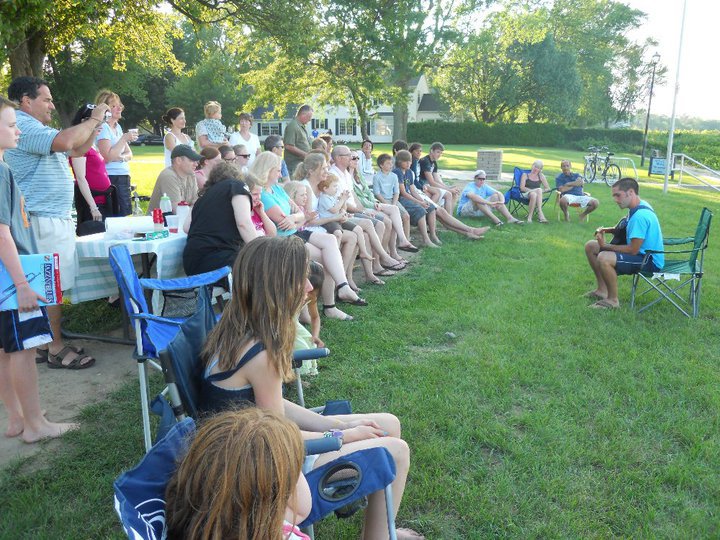
I am excited to be invited to speak at my local library as part of their annual speaker series. The single reason they were receptive to my "brochure" is because I adjusted my target to highlight my journey of discovery. I am joining them not because my book is such a sensation. In New England, far from Esther Miller’s roots, the attraction to the book about a girl from Ohio lies more in the research process than the story. And I have to say, I am thrilled to present my research journey, especially if it demystifies the process or encourages others to start their own search. Of course I would love to talk about Esther, but it would probably feel like sharing my home movies with strangers! Not that that ever stopped my Grandpa McCarthy – invited by the Lakewood Library, on many occasions, to show his films from his globetrotting!

I discovered that my local library offers free use of Ancestry.com from their PCs. I think this is a common, yet often overlooked, benefit offered by many public libraries. I spent hours there, inputting ancestral names, deciphering cursive census entries from the 1800s, following a genealogical path down the decades until I lost the trail, and combing through birth, marriage, and death records trying to match names and dates to fill in the missing puzzle pieces. I found the whole task utterly captivating and was often startled out of my seat by the library bell notifying patrons of the impending close.

Some people put off the research because it seems overwhelming, they think it will be tedious, or they don’t realize how accessible old records have become. Not only is it accessible, it is free. I gathered many stories and memories from my living relatives, but that still left many holes in the story. Every bit of research to fill in those holes came from sitting at my computer or the library’s computers – with the important exceptions of my mom and sister, Megan’s, fact-finding mission to Asheville and my time, elbows-deep, in the archives at the Western Reserve Fire Museum in Cleveland. There is so much at our fingertips! It is simply amazing.

It is off in the distance a bit, but mark your calendars for January 26, 2014 and please come to the Needham Library for a fun little journey. Party at my house afterwards! Complete with home movies.

Friday, May 3, 2013

The Risk of Waiting Too Long

Max & Edna (1940-something)
One of the many side-stories of my Preacher Kid writing journey involves my great uncle, Uncle Max. He was my grandma’s youngest sibling, born in 1919, when Esther was 11 years old. 

Like most of his siblings, Max Miller lived a long life. He stayed sharp as a tack right up until he died at the age of 87. Which is why I sought him out when I was trying to put the pieces of my grandma’s life together. He would still have the childhood memories, the stories of making do with what they had, the color on his parents, and the dirt on Esther.


It had been years since I had seen Uncle Max. I probably last saw him when I was in high school. He had lived with his wife, Edna, in Columbus and we used to love to drive down there and motor around on his pontoon boat that he docked at the bottom of the hill that led to their house on a lake. Max and Edna never had any children, but they loved children. It was always great fun to visit them and get a chance to laugh with Aunt Louise, who was part of the Columbus package.


So as my thoughts were swirling and forming in 2006, I wrote a letter to Uncle Max who had for many years lived in Lakeland, FL. In the letter, I suggested taking a trip to Lakeland, spending a few days with him, and capturing his memories as well as spending some precious time together.


Do you sometimes calculate a letter’s journey? I do it fairly often. And I knew that it would take 2 days to get from Boston
to Lakeland. Then I wanted to give him a few days to process the idea. Then I would give him a call.

The day before I planned to call Uncle Max, my mom called to tell me that Uncle Max had died earlier that day. He had had a long life. He died peacefully in his sleep, like the turning off of a switch. He had been a very small presence in my adult life but he was a link to my grandma that I had come so close to reconnecting. My husband jokingly blames me for Max’s death! But I’m grateful that perhaps Max opened my letter, felt love and appreciation from a distant source, pictured my sisters and I rolling and laughing down the hill in front of his house, thought about his long life and his family a bit, and smiled.


Many people’s reaction to reading Preacher Kid has been one of reinforcement that they should write the life story of a relative or other influential person in their life. I can’t tell you how many times I have heard, “I should write a book about my [fill in the blank].” Well, my advice to you is “do it.” And do it now, before it is too late! The book about my grandma’s life would have been exponentially richer if I had written it while she was alive and helping me. It would have been more colorfully illuminated had her brother, Max, had a hand in it. I think I did alright with the great help from my mom and aunt. But I wish I had written it sooner.


Do you have someone you want to write about? What are you waiting for?

Sunday, April 21, 2013

Help. Thanks. Wow.

One day, not that far from now, I’m quite sure my oldest son will run the Boston Marathon. On that day, my plan will be to cheer him on at the half-way mark, then bike into Boston to meet him at the finish line. It will be a forever-changed finish line from the pre-bombing one we were used to seeing. But I echo the shared feelings of those who love the Boston Marathon and its special day in firmly believing we will do everything we can to heal the survivors, honor the victims, and learn from this week’s horrible tragedy to enable it to continue as the iconic event it is. Saving the event is important for our city's and nation's psyche. But saving the shattered people left in the bombing's wake is the ultimate goal.
 

I have turned numerous times this week to Anne Lamott’s book, Help, Thanks, Wow: The Three Essential Prayers. This week, there was much reason to call out for Help. Not so much for Thanks and Wow. But in all of the stress, fear, and loss, the light of the Thanks and Wow poked through the black. And it is the sources of the Thanks and Wow – the first responders, others who responded when it was not their assigned role, courageous victims, the Boston police chief, our governor, the fantastic people of Boston & Watertown, the country that showed over and over that they care – that will continue to help us balance our new feelings of vulnerability with the courage we need to live in this crazy, unpredictable world.
 

Help the victims and their families heal physically and mentally. Thanks for the gift of people who, through training and/or instinct, run toward danger when they think they may be able to help. Wow, we are a magnificent, strong people when we put our differences aside and work in an amazingly united front, constructively toward a common goal.

Pray for Peace.

Monday, April 8, 2013

Starting from My Own Beginning

If you planned to go to an author visit at your local library or book store and your two choices were to see:

(a) a local author, discussing her first book about a 20th century woman who spent most of her life in a distant state or 

(b) an author visiting her childhood city, discussing her first book about a 20th century woman who lived in your city, grew up in your state and had family connections throughout your region, 

I think most would choose the latter. With this in mind, I’m focusing my initial marketing efforts in the Cleveland area, with a parallel campaign in the markets near my current home.

Two Cleveland Plain Dealer (PD) columnists I enjoy reading are Connie Schultz and Regina Brett. So they have landed on the top of my target list. Ms. Brett was even nice enough, two years ago, to suggest a Cleveland publisher to me. That publisher is also on my list – I’m always open to allowing second chances! When I crafted my letters to these Clevelanders, I leaned heavily on my Grandpa Joe’s memory, even though I think they will find my grandma’s story compelling purely from their own personal vantage points.


Amazingly enough, the man at the PD who edited my grandma’s obituary and both of my parents’ obituaries knew my grandpa personally. There are still people at the Plain Dealer who were starting out as my grandpa was exiting, who remember him. Columnists for the Plain Dealer should recognize his name. If not, I would highly recommend that they set aside some quality reading time in the PD archives with some of Joseph F. Saunders’ columns, getting to know him and Cleveland in the mid-1900s.


Here is what I hope will pique these Clevelanders’ (and others’) interest:


  • One of the book’s main characters is Joseph F. Saunders who was a reporter, editor and columnist for the PD from 1937-1968.
  • Joe Saunders’ PD columns helped Carl Stokes win his election as the first African-American mayor of a major US city.
  • Esther lived in Cleveland from 1932 to 1969 after escaping a life of near-poverty, moving around rural Ohio as a “Preacher Kid.” Esther married Joe Saunders and moved into the house where he was raised on W 74th Street, the heavily Irish area of Cleveland’s near-West Side.
  • Joe was a graduate of John Carroll University and his father was a Cleveland firefighter who was killed in the line of duty when Joe was 2.
  • Bernice Secrest Pyke (the first woman appointed as a delegate to the DNC – 1920) helped her niece, Esther, land a job in Depression-dimmed Cleveland in 1932. Esther’s job was with the newly-formed Federal Reserve Bank where she was paid in script.
I am hopeful that these writers, as well as the independent bookstores scattered around Cleveland, will be drawn to Esther’s story. My friend, Leslie, made the very true comment that people whose lives are mostly put down as “ordinary” by all accounts, are anything but. I hope others see that in Esther’s story.

One of my personal goals is to interest Rocky River Public Library in an author visit highlighting Preacher Kid. Not only did I spend hundreds of hours in that building in my pre-internet youth, but Esther was a patron as a Rocky River resident, it never stopped being one of my dad’s favorite places to explore, and my mom served on their Board of Trustees for a number of years. If I were given the opportunity to discuss Preacher Kid at the Rocky River Public Library, I would most certainly be visiting in my family’s honor.


The Cleveland area is my starting point. But I’m pulling out my map of Ohio again and charting my course to match my grandma’s journey. And figuring out who I can stay with along the way! Cleveland is all set – thanks Anne!

Sunday, March 24, 2013

Develop a Family Narrative

Twenty-seven years ago – anxious to try something new, but not really ready to leave – I made the decision to try a new city, thinking at the time that I could always move back home. One of many naïve views I’ve managed to prove wrong in the last 27 years, I still find myself, on many occasions, wishing I lived near my original family. Yet I remain extremely fortunate that the bond I have with my Midwest and DC family is incredibly strong despite the distances.

An article which appeared recently in The New York Times, The Stories That Bind Us, does a terrific job of illuminating an essential contributor to that family bond and the resulting resiliency: developing a strong family narrative. Amazing is the finding that children build self-esteem and resiliency simply by understanding that they are part of something bigger than themselves. As my children study the lives of explorers, celebrities, and famous people who left important marks on our world, it is really the stories like that of their great grandfather who came over from Ireland, alone, with just the shirt on his back at 16 years-old or the great-great-great grandfather who was a drummer boy in the Civil War that stir their underlying sense of self, mold their ideas of accomplishment, and fuel their internal motivation.


They don’t have to be heroic stories: Simple stories of regular lives, describing adversity overcome or the roller coaster ride of experiences, connected by some small, thin thread to who we are today. Those are the stories that bind us together. 


No one likes a good story better than I. That must be why I enjoy my family full of story-tellers so much. I am usually in the audience, rarely the narrator. But I am so glad I sat down and documented my grandma’s story. I started it as a preservationist, but it grew into something more. Reading the NYT article gave me a sense of support, that others see the value in understanding our roots beyond knowing the branches of our family tree. The stories hanging from those branches are priceless in so many ways. 

As we chart our own journeys, we find strength in the traditions of the past. We serve the menu that has come to represent a holiday over countless years. We bake the Irish soda bread using Nana's recipe. We gather as best we can, in honor of the family gatherings we've had since there was family. We learn and gather strength from one another, across generations and across state lines. We absorb new characters into the forward-moving narrative, through friendship, marriage, birth, and adoption. And we start traditions of our own, such as our family talent show, that find a comfortable, enduring place in the narrative.


I see the importance of the narrative from a business perspective as well. As I analyze new markets in my day job, I recognize the need to understand and appreciate the business’ core. As we step, tentatively or boldly, into new markets with new products, it is important to maintain an appreciation of our roots. Those origins are at the core of our success and new opportunities will only grow from lessons we have learned and merits we have earned along the way. The message we build for the new markets must be based on the narrative we have developed in getting to where we are.


But my favorite parts of the NYT article have to do with the family narrative. When my inner child needs a boost to keep the ‘happy’ in my family, I think I’ll watch my old home movies. Overcoming the styles of the 70s is hardship enough and a recurring subject of our family narrative. What is in your narrative? And have you told it to anyone lately?

Friday, March 15, 2013

Understanding What a Book Means to its Readers

Miller Family: 1920
When you pull together a book documenting a family member’s life, it is hard to look beyond what the value of that story is within your own family. I definitely set out on my writing journey with the objective of capturing an interesting story about an amazing, beloved person so that her story would not be lost to time. The idea was to create a gift for future generations while satisfying my own desire to write.

That gift for future generations is still my overriding objective and I am happy to see it fulfilled. But what I am discovering as the story circulates is that what is important about Esther’s story to me may not be what is important to other readers. In other words, Preacher Kid has other meaning to people who never knew Esther Miller. And understanding those alternative meanings will help me market the story and share her life with a broader audience.


I had the good fortune of being invited to a book club meeting of women who read my book and wanted to discuss it with me. I knew three of the seven women at the meeting, so it was interesting to get the perspectives of some people who know me and others who do not. We had a great discussion and they gave me many good questions to ponder. I saw as the meeting unfolded that two of the underlying themes of the book really resonated with this group: Esther’s adaptability and the importance of preserving family memories.


My grandma amazed me and all of the people who understood her journey with her adaptability. I’m thrilled that I may have successfully captured it in the book. There is a distinct possibility that people confronting their own challenges and being forced to adapt in order to survive might find inspiration in Esther’s relentless adaptability. I recognize this from an adult perspective as well as a teen perspective. When I contemplate what age groups this book may target, I consistently imagine adults, but I will not overlook the teens. Even though it lacks the standard teen genre themes of today (vampires, suicide, pregnancy, etc.) it may resonate in the teen psyche from a different angle of survival.


What I am growing to appreciate is the interest people are taking in the book simply because it captures a family story. I have yet to meet someone who does not have a family member, alive or dead, whose story they would like to preserve or wish they had preserved. What is holding them back? Time, energy, life, resources. There are many reasons that make it hard to get started or to carry it through. It is a big project; there is no doubt about that. But I feel, in a way, I am a poster child (woman) for getting it done! When I look back at all of the reasons why it took me 6 years to write this little book, any one of those reasons could have been the sole reason for abandoning the project or sidelining me from even getting it started in the first place - I had very little documentation to go on, my main subject and all of her siblings had already passed away, I was raising three small children, I was trying to hold down a real job, etc. One of the most compelling moments of the book club meeting, for me, was when I pulled out the 12 pages of hand-written notes my grandma wrote to my sister in 1989. To be an example of having taken her story from those twelve pages to the book in my lap was rather powerful.


When I approached my local library with the offer to discuss my book as one of their programs, they were intrigued. They are considering my offer not because it might be a captivating story or that I might be an astounding author hidden in their midst, but because I was careful to stress how much I used library resources for my research! In my library pitch, I tried to put the pieces of the puzzle together to create an image that is a familiar desire for many: a non-author with a family story to tell, capitalizing on the databases in which the library invests, creating a memory out of very little, and publishing it as a book, making it available on the most widely shopped network in the land. I hope they take me up on my offer and I hope to get the same response from libraries in the Ohio towns where my grandma lived (Naples wouldn’t be bad either!). If I could present to a group of interested readers (or potential readers), and out of that group, one person commits themselves to documenting the story of an elder, I would feel as though I had really accomplished something. Preserving that story is such a great task to embrace and complete. It is a task completely void of any regrets.


If I get the library gigs, I’ll be sure to post the dates here! I’d also love to be the guest author at your book club!

Wednesday, February 20, 2013

One Letter Can Go a Long Way

I have had an interesting and informative couple of months engaging different experts in conversations about our town’s school safety protocols and gun safety. For those interested in where my January letter to the Needham Times has taken me, I would like to describe my efforts here. I would guess that similar experiences are being logged around the country, so even if you are not from Needham, MA, you may be interested in this journey. 

My letter which was printed in the January 3rd edition of the Needham Times was shorter than, but similar in theme to, the post I included here on December 19, 2012. The letter included a link to an online survey to gauge the interest of readers. The response to that letter was overwhelmingly in favor of a discussion or coalition of related groups to discuss improvements in Needham's school safety protocols and access to/awareness of mental health support systems.

With collected survey responses as support, I contacted our School Committee members, our Youth Services Director, and our school Superintendent. I have had productive conversations with the principals of my local elementary and middle schools and I was invited to participate in their Health and Safety Committee meetings. I also met with our school superintendent and the director of our Youth Services organization who were both very welcoming of a dialogue and gave me confidence that our students' safety is of the utmost importance and that it is in good hands. Regular review of safety protocols and of mental health service offerings is invaluable and is occurring here.


The high school principal and I had a productive email conversation where we both learned from each other. Specifics shared with me by the principal may be of interest to readers

"...we work with the town on a regular basis to review our safety protocols and procedures. We routinely meet with the Public Facilities, Police, and Fire Departments to review and update our security procedures and protocols. For example, the building-based Health and Safety Committee meets to monitor and address emergent facilities and safety issues, and I meet with Local Emergency Planning Committee, which is made up of all town chiefs (police, fire, etc.) and department heads, to plan for different types of emergency situations that might involve the high school. 

"Earlier this year we began the process of updating our master key system to enhance our lock down protocols. Over the coming summer we will purchase and install a new digital radio system that will provide all offices, administrators, and department heads with campus-wide instant communication access in the event of an emergency. We have also planned to install a card/key fob access entry system for faculty and staff over the next 1-2 years which will further restrict access to the building during school hours. In addition, this will allow us to prevent doors from being propped open and to track more closely the comings and goings of individuals as they enter and exit the building."

I see three take-aways from my efforts:
  1. My initial plan was to help bring together various expert groups to have a dialogue that would be beneficial to improving the safety of our town's children and all residents. I feel now that some of those conversations are already happening. Although the conversations are not taking place in one central forum, I understand that they are taking place through various committees and relationships. The tragedy in Newtown has heightened all related groups' interest in providing safe school environments for our students. I feel confident that the best people are staying tuned in to the problems and I will continue to offer my help as a liaison between parents and Health & Safety Committees.
  2. The conversations I have had with two principals have resulted in improved guidelines and execution of safety protocols at those two schools. I understand the steps that have been taken at the High School in recent years to improve student safety and my concern about unlocked doors was listened to and will be addressed as soon as possible. None of the schools will ever have perfectly executed safety protocols, every minute of every day, but the plans and intentions are in place to make the schools secure. As visitors of our schools, we have a responsibility to adhere strictly to the security guidelines and to report security breaches when they happen. Our school superintendent is considering increasing the frequency and methods of communicating school safety protocols and improvements – look for his updates on his Needham Channel broadcasts, in the annual Needham Public Schools Performance Report, and possibly in other ways.
  3. I have been invited to assist one of our ministers from the Congregational Church of Needham in organizing a public forum. The forum’s agenda is under development but it will aim to address gun safety as a matter of public health. It should be a very helpful event for our town and I hope to add some value to it and to others like it. The rough goals of the event are:
  • To raise awareness in the community about the presence and reality of guns in our midst
  • To educate ourselves about gun safety as a matter of public health

Lastly, over the past two months, I have come to understand the importance of speaking up for something, even if it seems as if one voice cannot make a difference. The letters I and many others have written in the wake of the Newtown, CT tragedy have started a chain of events in the right direction toward tightening of gun control, increasing gun safety and improving public health. Letters written for publications can inspire readers to act in unanticipated, helpful ways. The letters we write to elected officials do matter. Our government representatives are getting the message – from many. I encourage everyone who is concerned about assault weapons in our communities and loopholes in our gun laws to take the time to make your views known to your elected officials. Email makes it so easy to contact them. If you have already contacted one or more, do it again. Sincerity and frequency matters. Keep repeating the message in order to compete with those emailing and calling with an opposing message.

When a mentally unstable gunman decides to enter a building – whether it be a school, a movie theater, a mall, or a workplace - he will most likely succeed. The best way to minimize those occurrences and the number of resulting casualties is to decrease the accessibility of guns, ban assault weapons and their large-capacity magazines, and strengthen our mental health support systems. The forum I describe above is a small step toward raising the public's consciousness of the prevalence of guns in our community. I hope that from it will come further action by individuals to prevent gun violence. This is a complicated problem that needs to be addressed from many angles. A simple, sincere letter can make a difference, even from one person.


p.s. Please do not comment if your comment includes an unrelated link. I review all comments before they are posted and do not post ones containing unrelated links. Thank you!