Tuesday, April 15, 2014

Always Adapting

We all have to adapt to survive. In fact, even though we don't like to admit it, we are in a constant state of adaptation. We like to believe that we are in control of our lives, as well the lives of the dependents in our care. And we can usually perpetuate the mirage of control, until one of life's larger forces rears its head - such as illness, accident, or death.

My grandma, Esther, mastered the art of adaptation, but I don't believe she purposefully schooled herself in adaptation. I think her ability to adapt came out of a deeper drive, lodged down in her soul, that placed survival above all else. Adaptation became a by-product of survival for her, as it does for many of us. Esther adapted to her nomadic life as a Preacher Kid, the chasm created in her family by her marriage to a Catholic, the sudden death of her 11 year-old son, the taking of her home by the state, and the deaths of her three spouses. Her story of adaptation in the face of adversity is an inspiration to people facing challenges of their own.

Whether it is a chronic illness, handicap or death of a child, depression or mental illness, relentless addiction, the premature death of a spouse or parent, a dooming medical diagnosis, a tragic accident, or a dramatic shift in life's course, we all have experienced tragedies or watched others navigate their own. But we adapt. We soldier through. We give support. We accept help. And what was once unthinkable or nightmarish, becomes the new normal. If it weren't for role models of resilience, we would be lost.

On this anniversary of the Boston Marathon bombing, I think about the Richard family who lost their little boy, Martin, in the blast. As Denise Richard surveys her surroundings through her one eye that she did not lose to the bomb fragments, she may see her husband's permanent scars and compensate for his hearing loss. She would see her daughter with her prosthetic leg and her surviving son with his lost innocence who saw more horror and loss in an hour than most Americans see in a lifetime. But she also would see the living room full of friends and supporters who sit down with her family to discuss and decide the best course on which to move forward to honor Martin's life. The Richards have chosen the shadows in which to learn to acclimate to their new normal. But today forces them into the limelight. And their presence and resilience is nothing less than heroic. I hope these days and weeks under the microscope are not too hard on them.

I have had the sad experience of feeling the shroud enveloping the community that lost a child. The heartache of everyday activities is soothed by the love of the community that understands the space the family must be given, but also the arm stretched out at just the right time and length to assure the family that they are not alone. One of the most poignant moments of my grandma's life was when a couple reached out to her family after the death of her son, when everyone else around them chose only distance.

I look to my grandma for inspiration when I am conscious that I must adapt. If I didn't have to adapt, I would be heading to Rocky River this July to visit my parents. But instead, I have the honor of presenting at the Rocky River Public Library. I am looking forward to the evening with great anticipation. It will be a genealogy discussion similar to the presentation I gave in Needham, MA in January. I am a bit overwhelmed - in a positive way - at the prospect of presenting my genealogy journey and my book at the library that helped foster my love of reading. If you are in the Rocky River area, I hope you will come! If you are busy that day, you will soon be able to check my book out from the library. And I hope my donated books will be given book plates in memory of Jack and Peg McCarthy, who will be at the presentation in their own, special way.

Author Visit: "Are You Ready to Find Your Family Story?" Wednesday, July 23rd, 7:00pm, Rocky River Public Library Community Room

If you would like to support the MIT community and survivors and families who lost loved ones in the Boston Marathon bombing, here are some great sites:

Sunday, March 2, 2014

How the 40s Look from Here

I crossed the threshold to 50 recently and have been trying to decide whether to take a moment here for a personal blog post about that milestone. Then my wonderful big sister did it for me. She wrote an amazing response to a NYT piece and, in her response, beautifully summed up her 40s from her rear-view mirror. Here is guest blog post author, Maureen Lewis, with a take on the 40s, like no one else can write.

About the 40s...

An established author and New York Times Op/Ed contributor wrote an opinion piece in the NYT a few days ago titled “What You Learn in Your 40s.” That’s all well and good, and I’m certain a lot of people read it (what with it being by a best-selling author, and, you know, being in the NYT…). But I had a tiny problem with the fact that she wrote it on the eve of her 44th birthday; I really have to believe (or HOPE to believe) that she has NOT yet learned all that she will learn in her 40s. 

So, I thought about it, and tossed together some of my own discoveries from that decade, ones I’ve experienced myself and/or shared with my friends and contemporaries, all of who, like me, are freshly arrived on the other side of our 40s. What we say about that: truth. Or as my slightly-more-badass friend Maria says: church.

This is the decade where your parents might get hit with some bad news about their health. If not your parents, then the parent or parents of your friends. Your parent, or parents, or those of your friends, may die. Suddenly, it becomes a priority to get your business in order, square up your relationships if they are not there already, visit more, drop what you’re doing and get there. I think the 40s taught me a lot about the fine art of showing the hell up.

You may have a peer get hit with a tough medical diagnosis. Or it might be you who is on the receiving end of some real bad news. You may bury your college roommate. But before that, when she calls to tell you the cancer is back and she’s entering hospice, you and all your other college roommates fly across the country, shipping Wisconsin custard to arrive there at the same time, and spend an unforgettable weekend in the mountains, eating too much, staying up too late, laughing til you weep. You don’t hesitate, and you show the hell up. Later, about six months after her death, you all fly again to the other side of the country to walk/run as a team in a national event for the Cure. And when you’re done doing that, you sit-and-drink-by-the-pool-for-a-Cure, and call that an event, too. 

You get to conflict with your kids. In order to not have an ulcer, you decide that year (or two) that you butted heads over politics or policy with your teen-who-knows-everything is in fact your opportunity to teach about disagreeing respectfully, about listening to both sides, about not strong-arming anyone into an opinion. Then much later, when that same son studies abroad for a semester, maybe you’ll receive the best Mother’s Day email ever, that says in part, “if I could go back and do one thing over, I would kick high-school-me in the ass.” It’s lonely on the high road, but when the sunrise comes, it’s pretty stunning…it’ll blow your hair back.

Listen to music your kids like, and have them listen to yours. Maybe then when your son and his buddies form a band and are playing out live somewhere, he’ll introduce a Warren Zevon cover with, “I learned this from my mom.” And maybe one day, someone will play you a song on the guitar, from deep in the archives, and tell you, “this makes me think of you”, and that may also blow your hair back. It’s important to be loved, but it’s profound to be understood. Also, watch movies your kids like, and have them watch something you like. That’s how your kids will know that “Chicken Run” is the same story as “The Great Escape.” If you’re exceptionally lucky, one of your favorite movies (“The Intouchables”) will be thanks to a recommendation from your own child.

Teach your kids to man up, to lead not follow, and to care for and include others. They may find they like that role, and you may find yourself in an all-school assembly where your 17-year-old son is the speaker, and talks eloquently about how when both of his parents were diagnosed with cancer, others picked us up and carried our family, and that he now believes our role as members of a community is to create a Body of Christ, by accepting help that is offered to us and by in turn offering a helping hand to others. That’s his definition of purpose, but you can adopt it as your own. In your 40s, you may learn from those you’ve taught.

You don’t get much vacation time, but take a week to chaperone a teen service trip to Appalachia. You might learn to attach underpinning to a tornado-damaged mobile home. Or, you may get to watch your daughter’s face as she sees a man in a wheelchair use the ramp she and her team built to enter the home he hadn’t been able to live in since a storm ripped his old ramp away. You can talk about the importance of giving, or you can walk the walk. Maybe your daughter’s friend (the one who has vacationed with your family, and been like a bonus sister-daughter to your family) will ask you to be her Confirmation sponsor because she likes the way you try to live a message of service.

Make new traditions. You might have to. Both your parents could die a year apart, and your childhood home is sold, and you have no physical connection to your hometown. You have no one there to spend Christmas with, and nowhere to stay. So your sister finds a rental house in the rural area near your hometown, and you all go there and build a new idea of holiday. And when you put up the tree that first year in this new unfamiliar place, and there is no tree-topper, your daughter and nephews fashion one out of cardboard and duct-tape, and that too becomes part of your new tradition.

You can learn something new, and you should. You might change careers, because you want to, or because you have to. You might find that it is indeed possible to pursue a Masters of Arts in a field you love, even if that pursuit includes 700 daunting hours of supervised clinicals in addition to working full time, raising a family, and having a home life. You get a lot of street cred when you tell your kids to buckle down and do school-work, while you are doing your own. Even better if you put your phone away while you do it; that resonates with them. But when you walk across the stage, in cap and gown, the last month of your 40s, to receive your degree, hearing “YEAH MOM!” shouted from the balcony is pretty awesome.

You may end up getting a dog. Even if it loves your husband best, you may witness that dog’s ability to make him a better man (as dogs are wont to do), and bring out the best in him. Or the dog may love you best, and you may learn a whole new chapter of the meaning of companionship.

Give books 30 pages to pull you in, even if you’re a voracious reader. Life is short and there are unanticipated struggles; there’s no need to struggle through a book.

Get fit. You realize this is the body that’s going to take you the distance. Honor it with real care. You might find out you really like lacing up your running shoes and getting out for a few miles at sun-up.

Figure out you don’t need ‘things’ as gifts. The best gifts are time together, a sweet note, lying in bed watching ‘CBS Sunday Morning’, sharing coffee, or a gift-card for a session with a personal trainer, or a voucher for airfare to go see your sister. Get rid of the things you don’t need.

Talk to the ones a generation ahead of you. Get those family stories written down; archive your story or have your talented sister self-publish the narrative that is your history. Have your mom teach you how to make those popovers; but if she’s gone too soon, and you still don’t know how to do it because you never asked, let that be your only regret. Those were some damn good popovers she made.

Donate the jeans that are too small. Buy the comfortable boots. Bring flip-flops to wedding receptions so you don’t have dance in killer heels. Eat pancakes for dinner. Cultivate friendships with your girlfriends; you know you’d be lost without them – tell them so. Sing along to “Brave” or “Countdown” even when your daughter’s friends are over.

Tell people you love them, even if you’ve never said it before, or you haven’t said it in a while, or maybe you just haven’t said it yet today. Hug the ones you love, leave nothing unsaid, and enjoy every sandwich. I’m no longer in my 40s, but I’ve learned a lot, and plan to learn a lot more.

Sister-extraordinaire, Maureen McCarthy Lewis

Wednesday, February 5, 2014

Find Your Family Story

My Miller Roots: Esther on the Right
A big "thank you" to all who attended my talk at the Needham Public Library on January 26th. I loved every minute of it. But some of the best parts I couldn't have possibly anticipated.

Showtime was 2:00pm. I arrived at 1:15pm for an equipment check and I was not the first one to arrive. Besides the wonderful Friends members who were setting up, there were two guests who had arrived together early to take the extra time they needed to get good seats. They were followed closely by a handful of other early arrivals who came in pairs: a son and his elderly mother, some friends, and two sisters. One of the sisters offered me the speaking tip, as a former despiser of public speaking, to hold my pointer finger to my thumb as a stress diffuser. She and her sister also told me, with examples, how much they love people from the Midwest, so they won me over right out of the blocks. Actually, they had me at "We've been talking about this all week."

After the talk and questions, a number of people approached me with tales of their own genealogy research, one woman even carried a prized research document. From my friend who came here as a young woman from Ireland, who knows all about her ancestry, but is inspired to have her daughter sit with her mother and write down her stories the next time they go "home," to the retiree who asked me to sign my book for him as he explained how he recently buried his father and brought his mother to the event because they are interested in exploring their genealogy, it was a wonderful, heartwarming experience for me. There is strong interest in the subject of family genealogy and a sort of "strength in numbers" as people who work away at it on their own feel a collective boost from learning or knowing that others are doing the same. I think it makes what can be a somewhat solitary job feel less lonesome. Not to mention the boost given to those who have thought about beginning the journey and attended the talk to get started in the right direction.

I'm fortunate that my son and husband recorded my talk, even though I was at first skeptical about having my family in the front row! I've added a link to the recording (now a YouTube video: Are You Ready to Find Your Family Story?) here and as a permanent addition to my blog (the smaller screen seems to give the best resolution). It would have been silly to record the before and after conversations because it would have been impossible to capture my feelings or the sincerity of the people I met. But those are great personal memories I am now the better for having. 

If you missed the talk, I hope you have time to view the recording. My cameraman had to switch cameras with about 3 minutes left, so the last few minutes are not as clear. But you can get the general idea in the other 45 minutes. In case you can't make out the last few minutes, I closed with the story of my Uncle Max, previously blogged about here, and the following advice: The genealogy resources that are available to us are amazingly large in volume, many are free, most are readily accessible, and all will continue to grow, but the people who are alive today to tell their stories won't be here forever. Don't waste any time in listening to their stories.

I feel as though I reached my talk's goal to inspire at least one person in the crowd of 50 to find their family story. I hope I have the opportunity to give the talk many times again at other libraries and other venues. There are so many people thinking about beginning the journey to find their family story and I want to say to them again, don't wait!

Monday, December 9, 2013

Mixed Motivations

As I prepare for next month's talk at my local library, I am creating a short presentation to try to capture the DIY genealogical research journey I took to fill in the holes in Esther Miller's story. As I analyze how I went from 12 pages of hand-written memories to a published book, I realize the importance of the motivation of the journey.

There are at least five common motivations for embarking on a quest to document a person's history:
  1. In homage to an influential person in your life
  2. A partial story begging to be completed
  3. Curiosity about specific, ancestral roots
  4. The desire to preserve a story for future generations
  5. The dream of finding a story worthy of publishing
There may be more, but at every point in my own journey, I was motivated by at least one of these, usually a combination of many. The degree to which each motivation guided me shifted constantly as I progressed. In the end, without all five of these motivators, I may not have finished the project.

Esther had been gone for over five years so I would miss the prize of showing her the story I had written. There are holes in her life story that I can never fill - and those who know me know how I have to find all of the pieces to a puzzle. This was a trait which made it hard to come to terms with the fact that I had found all I was going to find.

I developed a love of history of all kinds from my father - broad history but also personal history. So my curiosity in finding my Confederate South ancestry and my Irish ancestors' ports of entry kept me knocking on virtual door after door.

But my main driver was to preserve Esther's story for future generations. Even if I failed to find all of the pieces of the puzzle or identify the ports of entry or show Esther what I had done with her life story, I had enough to go on to create a gift for my children and nieces and nephews, and those who come after them. What I didn't realize was how much value the completed story would have to my family of my own generation, my parents' generation, and my family's friends.

The book has become a catalyst for reminiscing and discovering stories that had been forgotten. It has enabled some stories to be relayed that would have otherwise been too hard to tell. And there are few healthier pastimes I know of than sitting with a group, from two to many, of people you love, talking about people you love who have passed away, their antics and experiences, and the imprint they left upon us.

I can't write enough about the gratitude I feel from my sisters and aunt, so I won't even try. But a nice way to express it was a call I got Friday evening from one of my mom's childhood friends who lives in Colorado. We had a long conversation about my mom and Esther and she recounted some priceless stories that didn't make it into the book; stories of women and children whose younger lives I can only imagine, but whose souls I was privy to and whose memories make me laugh and cry. We talked about how reading the book made her relive some wonderful childhood memories, relish some teen secrets, and reignite old feelings. At the end of the call, my mom's friend said "I just wanted to thank you for writing it. That's all. That's why I called. Just to thank you for writing it."

It won't make broad distribution, as I admittedly had dreamt, in reference to point 5 above. But the story is all that it needs to be. And the gratitude is all mine. I'm not sure if the book is the end of the journey. But the journey to find my family story is one of the best trips I ever took.

If you are in the Needham area in late January, come help me fill the room on Sunday, January 26th at 2:00pm at the Needham Free Public Library. Or tell a friend who is interested in DIY family genealogy. The program is called "Are You Ready to Find Your Family Story?" The discussion will not be about the book. It will be about the journey.

Monday, October 21, 2013

Looking Local

In a round-about way, I recently discovered an organization that every independently owned business should know about: The 3/50 Project.

It is an organization, founded by former retailer, retail consultant, and professional speaker Cinda Baxter, built to strengthen independent brick and mortar businesses. Here is how it got its name:
  • 3: What three independently owned businesses would you miss if they disappeared? Stop in. Say hello. Pick up something that brings a smile. Your purchases are what keeps those businesses around.
  • 50: If half the employed population spent $50 each month in locally owned independent businesses, it would generate $42.6 billion in revenue. 
"Independent" merchants who have no outside corporate support of any kind are the same businesses who return the largest percentage of their annual revenue to the local economy, according to a 2009 Civic Economics Study. Stated on The 3/50 Project's website: "For every $100 spent in locally owned independent stores, $68 returns to the community in taxes, payroll and other expenditures. If you spend that in a national chain, only $43 stays here."

Those are good reasons for consumers to patronize their local independent retailers. And the free resources and networking offered by The 3/50 Project are good reasons for independently owned businesses to join their ranks of supporters.

It came as no surprise to me to see some of my favorite small retailers on The 3/50 Project's list of participating independents in my town. The 3/50 Project encourages membership and support from all around the country. It only started in 2009 and is on a great growth path (5,000 indie businesses joined in its first two months of existence and grew to 23,000 by 2011). I believe many, even most, people want the small brick and mortar businesses to survive, we just don't realize the impact of our dollars. The 3/50 Project spells it out and helps small businesses enhance their social media presence, network with each other, and find strength in numbers. 

In 2011, The 3/50 Project launched an iPhone App called LookLocal to give small business owners a tool in the battle for consumer attention. According to their press release, LookLocal features “independent brick and mortar” merchants, locating those closest to where the user stands, regardless of whether they are at home or on the road--a feature no regional or city-specific app can offer.

As The 3/50 Project seeks to make connections, I discovered it on my way to a wedding. I am heading to a family wedding in Denver on November 2nd and saw, on the website of the B&B where I am staying, a link to The 3/50 Project and I was curious. So I explored and found more. The B&B also has a close relationship with a local independently owned book store, The Tattered Cover. That prompted me to initiate a conversation with The Tattered Cover about consigning my book. Life is full of connections.

As the year's biggest shopping season approaches, look around you and find those indie retailers who need our support and whose creativity and hard work offer unique, high-quality products and services far above their bigger competitors with the big advertising budgets. They can positively impact our way of life more than we know.
http://www.indiebound.org/

Thursday, October 3, 2013

Learning from the Pros

While I was working on the research and writing of my book, I tried to read as many memoirs, biographies, and collections as I could. This tactic introduced me to so many different writing styles and was my D-I-Y approach to learning how to tell a story. From that collection of books, emerged my short-list of wonderful guidebooks:

  1. Growing Up, by Russell Baker: It still holds as my all-time favorite memoir. His gift of story-telling is unsurpassed. This should be read within the same 90 days as reading A Tree Grows in Brooklyn, by Betty Smith.
  2. Anything and everything by Anne Lamott, but especially Bird By Bird: Some Instructions on Writing and Life. For any anxious, new, blocked, or expert writers, this is a gem like no other.
  3. All Over But the Shoutin', by Rick Bragg. An unbelievable story told with incredible candor.
  4. Living Out Loud, by Anna Quindlen: A great collection of columns and perfect bedside book.
  5. The Glass Castle and Half Broke Horses, by Jeannette Walls. Thanks to Dennis, I have a signed copy of The Glass Castle with Ms. Walls' encouragement to me, "To Kathy, Good luck writing! Jeannette Walls"
  6. God Never Blinks: 50 Lessons for Life's Little Detours, by Regina Brett.
From the list, you can see that I am genetically predisposed to enjoy works by columnists! Ellen Goodman is my other go-to gal for describing the human experience and how it affects the heart.

So with my lessons from the pros, I plowed ahead and tried to write a book from my folders of research. In fact, I wrote the first draft of what would become Preacher Kid, from cover to cover, as a detached reporter focused on getting the facts right. Then after some soul-searching and life detours, I rewrote the entire book from a personal perspective, recognizing that my voice added value to my grandma's story.
,
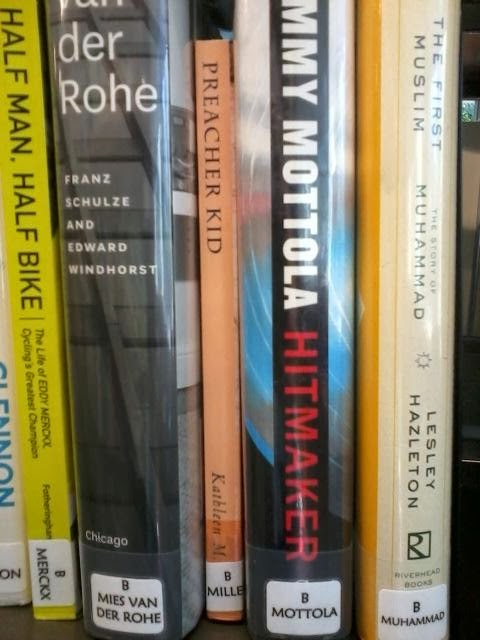
Preacher Kid on the Needham Library "New" shelf!

I think, over time, my voice may develop into something different, but will still retain a certain true core. When I write my next book (!), we will see if any evolution has taken place. One of my favorite voices to listen to is Anne Lamott. She has a freshness, intelligence, and liveliness found in her stream-of-consciousness writing that engages me as if she is sitting on my back porch, shooting the breeze with me. She writes with an abandonment I don't yet have. She possesses a window into my soul and much of what she writes articulates or uncovers true feelings I share. It is a fantastic combination.

And speaking of Anne Lamott, I won her latest book in a contest this week! When I saw that she was giving away copies of her soon-to-be-released book via Goodreads, I decided to click the button and enter.

I wrote about one of Anne's other books in a prior post. Her sequel to Help, Thank, Wow: The Three Essential Prayers was written in the aftermath of the December 2012 Newtown, CT tragedy. The book is titled, Stitches: A Handbook on Meaning, Hope and Repair. If you know me well, you can see the appropriateness, on many levels, of me winning Stitches.

Thank you to all of the professionals who have helped me so far!

Friday, September 6, 2013

Summer Reading

Well, August was a blur, but I did tuck in some good reading over the summer. I usually try to keep up with my boys and their required reading, while I sneak in a few of my own preferences.

I had never read The Hound of the Baskervilles, but always found Sherlock Holmes in his PBS and movie renditions so entertaining. Now I see the true talent of Sir Arthur Conan Doyle. In this world of connections, this classic was referenced in my freshman son's summer required reading, The Curious Incident of the Dog in the Night-Time, by Mark Haddon. That's two down. We both gave up on Robinson Crusoe, sorry Mr. Defoe.

As fully expected, I had trouble with the subject matter of The Things They Carried, by Tim O'Brien, but I see why he is acclaimed for his storytelling. He calmly conveys honesty and emotion as he recounts the horrors he lived. Plus, it is always wise to be reminded of the horrors of war as we teeter on the brink of another one. War tactics, strategy, equipment, and rationale are constantly changing. But the losses inflicted are a constant.

For my 6th grader, it was fun joining the adventures in The London Eye Mystery and Wonder: Two very different stories told from the stark perspective of uniquely gifted (or handicapped, depending on how you look at them) children, written by authors (Siobhan Dowd and R.J. Palacio, respectively) with great talents for teaching perspective through child narrative.

Quiet: The Power of Introverts in a World That Can't Stop Talking, by Susan Cain, is one of my own choices and, though only part of the way through, I am finding that it is shedding an amazing light on my own DNA.

One of my sisters gave me Wild: From Lost to Found on the Pacific Coast Trail, by Cheryl Strayed, and it propelled me into plans of my own future hikes, toward or away from things. I followed it up with Bill Bryson's always-hilarious A Walk in the Woods to get a coast-to-coast view of the value of getting off the grid.

I recommend these all, but the best book I read this summer was one I rescued from my parents' shelf: King of the Wind: The Story of the Godolphin Arabian, by Marguerite Henry. Better known for her stories of Misty of the Chincoteague, Henry had only recently teamed with horse illustrator extraordinaire, Wesley Dennis, when this book was published in 1948. Two rather magical auras surround the book in my possession. First of all, I lobbed the idea to my two youngest sons that I would read it to them because it had been my favorite. They humored me by agreeing and then became mesmerized by the story, begging me to read more. This can't possibly happen again. At ages 11 and 14, they won't possibly want me to read to them next summer, maybe not even next month!

The other aura surrounding the book is my re-discovery that it had been my dad's childhood book and had been signed by the author. Those facts had escaped me since my childhood. Where did he go for the book signing? How long did he wait in line? He was all of 12 years old at the publishing. Was it a family affair? Did he bring his kid brother along? Did they wear their cowboy hats and holsters? Why else would Mrs. Henry have added a hand-drawn horseshoe to her signature? It was certainly not the then-46-year-old author's first book signing, but I wonder how she felt at the time. The beautifully illustrated paper cover of my copy wore away years ago, leaving only the rich red hardcover. Its funny little book plate has a squirrel perched on a sign among leaves and reads: "This Book is from the Hoard of Jack McCarthy. Read Thoughtfully, Handle Carefully, Return Promptly." Done. If you have never read King of the Wind and if you ever loved horses, watercolor paintings, and good storytelling, I promise, you will enjoy this book at any age.

Do you have any book recommendations from your summer reading? Happy Fall!